LinkedIn Profile Signals: Australian National Guide | Grow Coaching
This is why you are not getting seen.
By Rushdi Kirsten
If you feel invisible on LinkedIn despite solid work, you are not alone. Most professionals treat LinkedIn like an online résumé, and résumés are read only after interest exists. LinkedIn decides whether interest exists, it is a search engine and a credibility page. If your profile reads like a task list, search will not find you and decision-makers will not click to read more. This blog post names the pain, explains why strong profiles earn attention and gives you a clear lens to judge whether your story lands in the Australia joab market the right way or not, but this is not a LinkedIn build guide.
Read more about Rushdi and credentials.
Why Your LinkedIn Profile Sends the Wrong Signals to Recruiters
Your profile signals the wrong thing at the wrong altitude, and you are sending a document for after the short list to a place that decides who reaches the short list. That mismatch is why you feel unseen and why you are not broken. Your signal is.
What that looks like
Headlines that echo your current title and hide the lane you belong in
About sections that list tools and tasks instead of decisions and outcomes
Experience sections that start with responsible for but never demonstrate what changed because of you
Tip: ever seen the phrase demonstrated experience on a job ad? This is what they are referring to...Featured left empty or filled with generic links, while the real proof sits in files or emails
Skills left broad and unpinned so search cannot place you
Why this matters in Australia
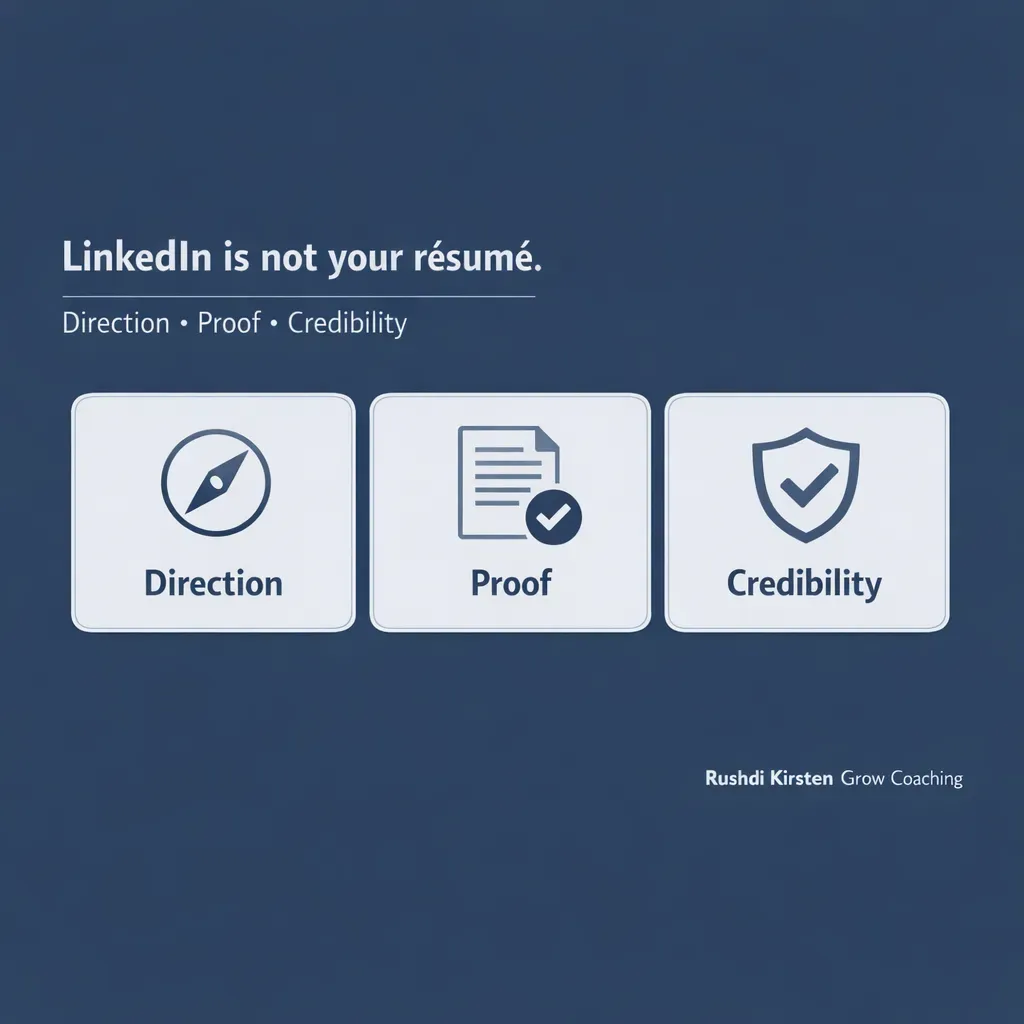
Hiring managers and recruiters search by exact words, skim one screen and make a call in seconds and they look for direction, proof and credibility at the top. If those three are not obvious and easy to find, they move on. The job market in Perth, Sydney and Melbourne is active but time-poor and clarity wins the click.
Pain you may recognise
You get messages about roles you have outgrown or roles that do not fit your lane
Warm contacts say they are not sure how to position you inside their organisation
You submit strong applications and hear nothing because your profile does not match what you claim on paper
You feel pressure to post more content when the issue is that your core signal is unclear
None of this is about your worth, it is about how the page reads to a recruiter or hiring manager scanning for relavence.
What hiring managers and recruiter scan for in ten seconds
Not tips. Just the reality of how people decide.
Direction
Can I place you in a lane without guessing?
Proof
Do I see two recent results that would transfer to my world?
Credibility
Do the titles, dates and language suggest care and judgment?
If the answer to any of these is no, attention drops, and the scroll continues.
How misalignment hides in plain sight
Language tells
We are across it or Happy to help or Passionate about excellence. These lines fill space but do not say what changes when you enter the room.
Layout tells
Your strongest proof sits deep in Experience. The top of the page shows generic claims, featured are blank, and skills do not match current Australian job ads.
Reputation tells
People describe you by the tasks you complete rather than the choices you steward. You feel flat because the page keeps you flat.
Reflection prompts rather than a checklist
Write answers as if no one will read them, honesty beats polish.
If someone saw only my top screen, what would they believe I can do or achieve?
Which two outcomes from the last twelve months would a hiring manager want to see first?
Which exact words would a recruiter type to find someone like me in Perth, Sydney, Melbourne or Brisbane? Do those words appear near the top?
What decision do people trust me to make? Where is that visible?
What would a sceptical stakeholder read and think yes, this person will make my decision easier.
If you want a calm outside read on your answers, book a short free career strategy call. The call is a diagnostic's call, it gives you insight and options, no obligations, just clarity.
The cost of pretending LinkedIn is a résumé
A résumé is static and long-form, but LinkedIn is dynamic, scannable and built for search. Treating it like a résumé has a cost.
Search does not find you for the roles you want
Good people never click because the first screen does not answer their question
You spend energy on cold applications because warm doors do not open
Over time, you start to speak less about your work because the platform reflects a smaller version of you
What a strong profile sounds like without telling you how to build it
It is quiet and specific, it names decisions and outcomes in simple terms, and it reads like someone who knows where they create value.
I owned the decisions that keep services reliable for customers.
In the last year, our team removed repeat incidents and lifted recovery to the mid-nineties.
I am the person you call when a choice must be made and kept.
No buzzwords. No performance. Calm ownership is what draws clicks and calls.
If this lands
Feeling unseen on LinkedIn is not a talent problem, it is a signal problem and if this language feels uncomfortably accurate, treat that as useful data. Decide what you want to be known for next, then decide whether you want to do the work alone or with a partner.
For structured help to sharpen the story and prepare for conversations, explore Job Ready Coaching and Interview Preparation Coaching.


