Leadership Clarity: Make Better Decisions & Reduce Communication Noise
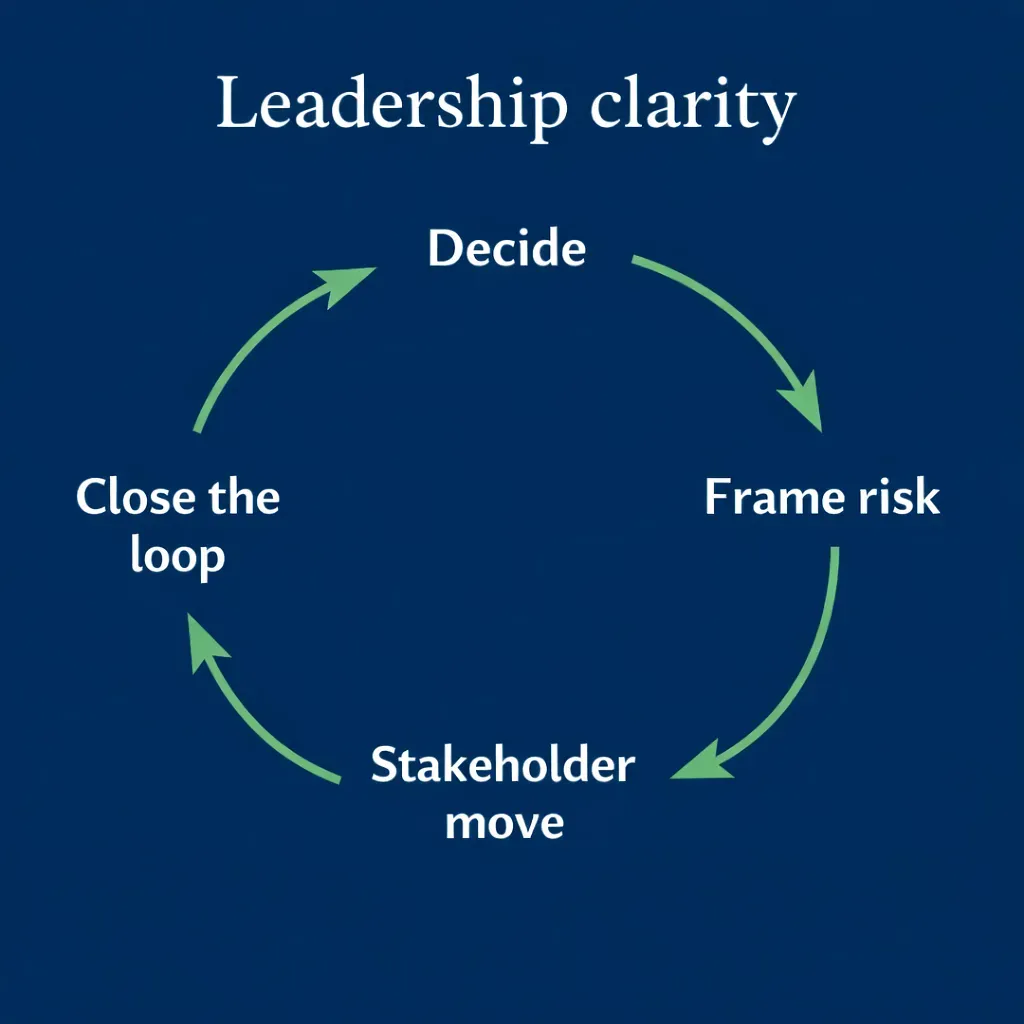
Leadership clarity
By Rushdi Kirsten
Leaders do not need more meetings or louder opinions, they need cleaner decisions that people can follow and when work moves fast the gap is rarely skill, it is usually clarity. Teams that move are the ones that make decisions the same way each week, with the same language for value and risk, and with the same rules for who owns what. This article gives you context for why clarity slips, practical tools to restore it, and a cadence you can start next week. You will leave with examples to copy, a run sheet you can print, and a simple scorecard to prove the change.
Read more about Rushdi and credentials
Why this matters right now
Across clients, I see the same pattern. The calendar is full. People work hard. Progress is thin. The issue is not effort. It is clutter in the way decisions are made and communicated. Three things drive the clutter.
Hidden decisions
Updates bury the call that must be made, so meetings swell and no one knows what changed.Fuzzy risk
Risks are listed without a clear control. People try to cover every angle which slows delivery and weakens ownership.No shared language
Different leaders use different words for value, risk and priority. Teams cannot align because the mental models clash.
Grow Coaching internal observation from the last twelve months across mid to senior teams in Australia.
Clarity fixes these by creating a shared way to speak about decisions. You do not need a new toolset. You need a simple rhythm and a few clean templates. If you want a deeper container for this work, explore my page on leadership coaching for cleaner decisions.
What leadership clarity looks like in practice
Leadership clarity is the ability to state a decision in one sentence, name the trade-off you accepted, and explain the control you will use to protect the outcome. It is not a performance. It is steady thinking in public so people can align and act.
Signals of clarity
A one sentence decision that a new starter can repeat
One main risk named in plain language with the control beside it
One owner and one next step with a date
A short review that checks the thinking as well as the result
The weekly decision cadence
Run this rhythm for four weeks. Expect meetings to shrink and cycle time to fall. If you want a quick outside view on your rhythm, you can book a short Clarity Audit.
Monday focus
Write three decisions only
Not tasks. Decisions that would move the work this week.Name one risk and one control
Keep it plain and practical.Stakeholder move
Who must find the week easier because of this decision. Write one action that makes it easier for them.
Midweek pulse
Ten minutes on each decision to confirm facts, remove a blocker or give authority
If a decision is not ready, write the one question that would unlock it and the person who can answer
Friday review
What changed because of each decision
Which decision created drag and why
What to do differently next week
Keep the review to fifteen minutes. You are checking decisions, not status.
The one-page decision memo
Use this for calls that matter. Share it before a meeting or attach it after you decide. Keep it to a single page.
Decision to:
Write the call in one sentence, clear enough for a new starter.
Context in four lines:
What triggered the call. Who is affected. What timing matters. What value is at risk.
Options considered:
Two or three only. One sentence each.
Chosen path and trade off:
State the call. Name the trade off you accept.
Risk and control:
Name the single risk that could burn you and the control you will use.
Owner and next step:
One person. One action with a date.
Review:
When you will check the effect and what would make you reverse the call.
You can print a run sheet version and hand write it. If you want a branded copy, tell me and I will send it with your colours and logo.
Before and after examples you can copy
Example one. Platform migration
Before
“We discussed the platform. Team prefers Option B. Risks to be managed.”
After
Decision to migrate reporting to Platform B by 30 April
Context service instability and cost growth in current platform. Finance and Customer teams affected. Contract renewal due in May. Outage risk and margin at risk.
Options extend current contract. migrate to B. split workload for three months
Chosen path and trade off migrate to B now and accept a six week parallel run
Risk and control data loss risk controlled by phased cutover and daily reconciliation
Owner and next step Priya to sign vendor SOW by Friday
Review service and cost check three weeks post cutover
Example two. Policy change with resistance
Before
“Stakeholders pushing back. We will keep consulting.”
After
Decision to publish policy guidance by 10 March with staged adoption
Context new compliance requirement from regulator. Operations and Partners affected. Fines and public trust at risk.
Options publish full policy in February. run pilot and publish in March. delay to Q2
Chosen path and trade off run pilot first which slows full roll out by four weeks
Risk and control partner resistance controlled by a joint briefing and a grace period for low risk items
Owner and next step Helen to confirm pilot sites by Monday
Review two week feedback loop then finalise wording
These examples are short by design. People can read them in under one minute. The record also speeds onboarding because new leaders can scan prior decisions and learn how the team thinks.
Meeting design that stops swell
Bad meetings are not a calendar problem. They are a decision problem. Use these rules.
Start with the decision required
If no decision is needed, cancel or replace with a short update note
Ask for the trade off rather than an update
End with one owner and one next step
Hold a five minute buffer to confirm understanding or to book any follow up
Agenda template
Decision we must make today
Two options in one line each
Chosen path and trade off
Risk and control
Owner and next step
Review date
Influence without theatrics
You grow influence when you make decisions easier for others. That means you show your working, meet people where they are and remove one obstacle that matters to them. Influence is not volume. It is clarity plus empathy.
Three micro skills
Start with their concern in their words
Offer a small adjustment in timing, scope or communication that protects their priority
Show the path to yes by making the risk and the control visible
Short script you can try
I hear that your concern is [specific concern]. If we adjust [aspect] by [small change] we protect [their priority] while still delivering [outcome]. The control will be [control]. Can we move on that basis.
The ten-minute case drill for leaders
Sometimes the right answer is not obvious and you need to think in public. Use this five step structure to avoid waffle in meetings and briefings.
Prompt
Name the core problem in one sentence.Clarify
Ask one or two questions to test the brief. People respect leaders who check assumptions.Structure
Outline a simple path. Assess. Consult. Decide. Communicate.Trade off
State the main risk, the control and why you chose that balance.Close
Give a one sentence recommendation that links to value for customers or the public.
Guide timing
Prompt one minute. Clarify two minutes. Structure three minutes. Trade off two minutes. Close two minutes.
Two mini cases from the field
Mini case one. Delivery drift
A service team kept slipping. Every risk spawned a new meeting. We flipped the cadence. Each week began with three decisions in a shared document. Each had one risk, one control, one owner. Meetings started with the decision and ended with one next step. Within six weeks throughput stabilised, meetings dropped by a third and the team recovered two mornings a week for deep work.
Mini case two. Incident response calm
A national team had long review calls after incidents. We introduced the one page memo and the ten minute drill. Debriefs moved from blame to controls. Leaders named one decision to stop repeat events, one owner and one review date. The number of open actions fell by half within a month because each action had a single owner and a clear finish.
Measures that prove clarity
You get what you measure. Track these for four weeks and share the trend.
Percentage of meetings that start with a decision to be made
Number of decision memos created each week
Cycle time from request to decision
Percentage of decisions with a named owner and a date
Friday review completion rate and the top theme spotted
A short line in your Friday note is enough. You do not need a dashboard to start.
Your 30-Day Plan for Decision-Making Clarity
Week 1
Publish the cadence and the memo template
Write three decisions for the week and name one risk and one control for each
Redesign one meeting with the decision agenda
Week 2
Run the ten minute drill in one live session
Create two decision memos and store them in a shared folder called Decision Library
Remove one meeting that does not serve a decision
Week 3
Coach two direct reports to write their first memo
Track the measures for the first time and share the trend
Run one short learning session on trade offs and controls
Week 4
Review what improved and what created drag
Tidy the library and highlight one memo as a teachable example
Agree two small changes to the cadence and keep going
Common traps and the fix
Reciting frameworks instead of making a call
Write the call in one sentence first. Then explain the thinking behind it.Risk overload
Name one main risk and one control. Park the rest. You can always add a control later.Jargon over clarity
Speak to value and risk in plain terms. Use the other person’s language for what they care about.Trying to please everyone
Decide who the decision is for. Optimise for that group and inform the rest.
Leadership clarity checklist
Three decisions written each Monday
One risk and one control for each decision
One-page memo for significant calls
Meetings start with decisions and end with owners
Friday review completed
One meeting is removed each week that does not serve a decision
Closing thought
Clarity compounds. When you write decisions in one line, name a trade-off and show a control, your team learns to think the same way. Meetings shrink. Work moves. You will not need to be the loudest voice in the room. You will be the clearest.
Next step
If you want a sounding board for your decision cadence, book a short call here. It is diagnostic rather than a coaching session. We will name one pattern that holds your team back, choose the first proof to publish and set a weekly rhythm that fits your load.
The full solution lives inside a coaching partnership.


