
How to Prepare for a Job Interview Without Overthinking
Most professionals who prepare too much don't actually feel ready; they feel overwhelmed.
Hours of notes, pages of example answers, every possible question is mapped out, and yet, sitting in the interview room, they blank on three of them.
This isn't a confidence problem. It's a preparation system problem.
When prep is unfocused, too many examples, too much content, your brain has no clear path to follow in the moment, and it stalls. You over-explain, lose your thread, or rush to finish an answer that started well and ended nowhere.
The fix isn't more preparation, it's a different preparation.
If you're still getting interviews but not converting them to offers, this is usually why.
The method that removes overthinking
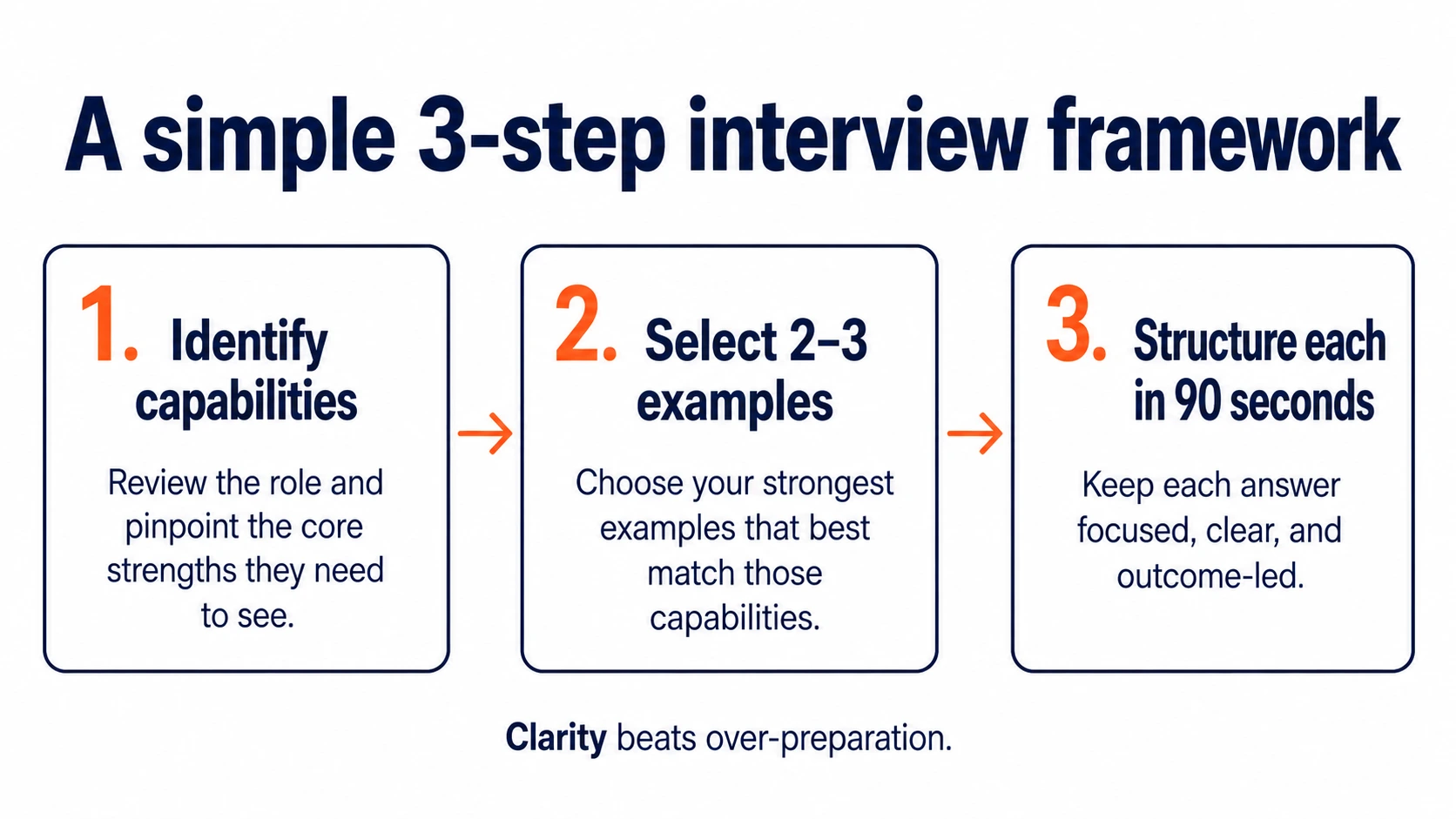
Effective interview prep comes down to three things:
Identify the 4–5 capabilities the role actually assesses (leadership, problem-solving, communication, stakeholder management, delivery under pressure)
Select 2–3 strong examples that cover those themes, not one per question, but flexible examples you can adapt
Structure each example so you can explain it in 90 seconds: situation, what you did, and the outcome in numbers or impact
That's it.
When you walk in with 3 well-structured examples instead of 20 half-formed ones, you stop juggling. You start communicating.
The interviewer notices the difference immediately.
Want to see what this looks like in practice? Here's a before-and-after of the same answer, structured and unstructured.
The one thing preparation can't fix on its own
Structure gets you most of the way there. But the structure you've built alone has a blind spot; you can't hear how your answers actually land from the other side of the table.
That's where a focused prep session changes everything. In 60 minutes, you walk away with 2 fully refined stories and a framework for handling any question they throw at you.
Got an interview coming up?


