
How to Answer Interview Questions Clearly and Confidently
You know your experience. You've done the work. But in the interview room, something gets lost between what you know and what comes out.
That gap between capability and how it lands is what costs people offers at the mid to senior level.
Here's what it looks like in practice.
That gap, between capability and how it lands, is the reason most experienced professionals don't get the offer."
The same answer, two ways
Imagine you're asked: "Tell me about a time you managed a complex stakeholder situation."
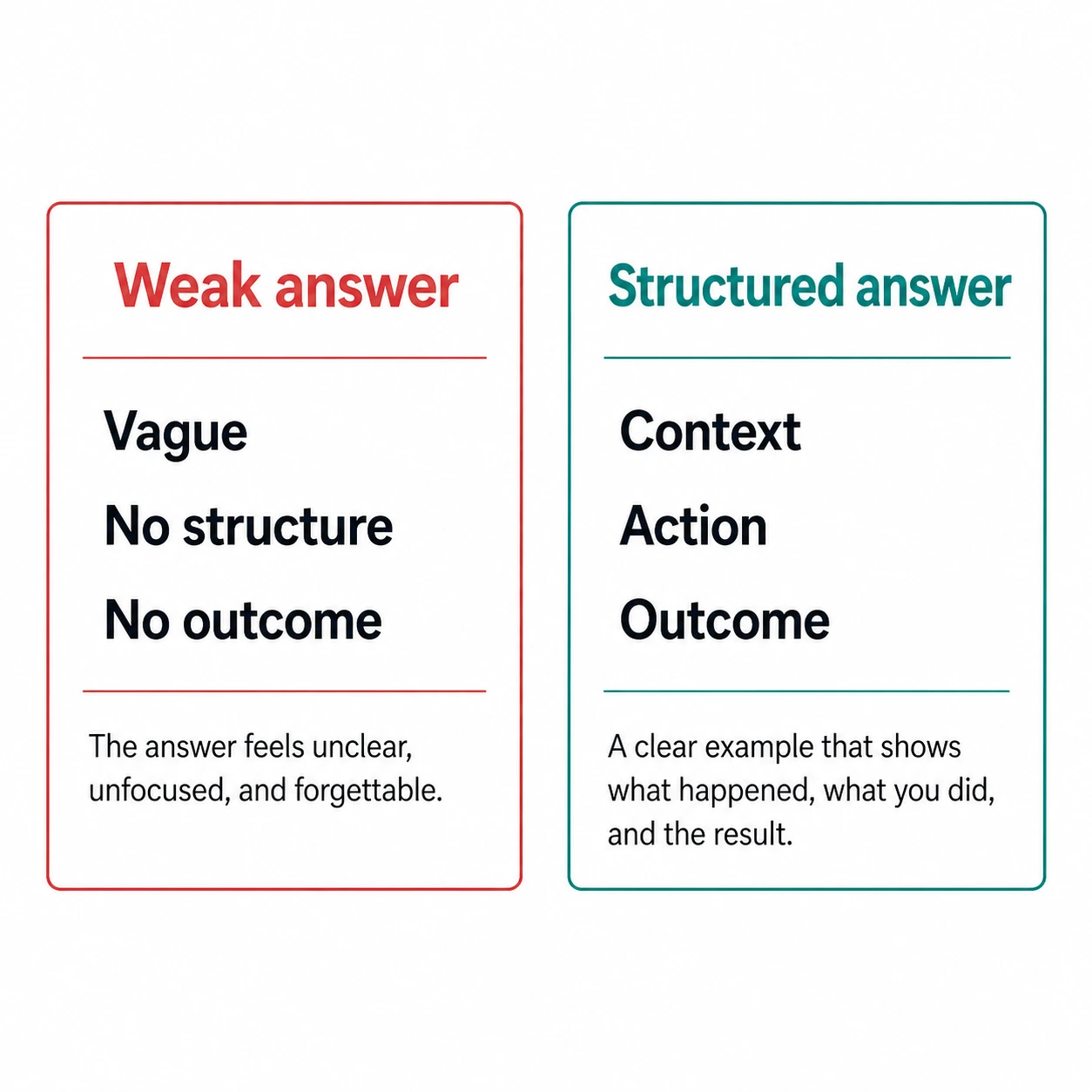
A typical response: "I've worked with a lot of stakeholders across different teams and always made sure communication was strong. I used to run regular updates and make sure everyone was aligned."
That answer is vague. The interviewer can't extract a situation, a decision, or an outcome. They move on.
A structured response: "We had two business units with conflicting priorities on a system migration that was already three weeks behind. I set up a weekly steering group with both heads, introduced a single shared risk log, and within a month, we had sign-off on a revised timeline. The project was delivered on the new date."
Same person. Same experience. Completely different impression.
The difference is structure, not confidence, not seniority, not even preparation volume. Structure.
The preparation method that builds these answers consistently, without overthinking, is laid out step by step here
The three-part framework that makes answers land
Every strong interview answer covers exactly three things, in this order:
Context — what was happening and why it mattered
Action — specifically what you did (not "we" you)
Outcome — what changed, in numbers or concrete terms
When you build your answers around this, you stop trying to remember everything and start following a path. The interviewer can track your thinking. You stop rambling. Your delivery feels controlled.
That's what reads as confidence.
"I walked away with clear, memorable stories and felt completely prepared for the questions that mattered." Nathan B., Operations Supervisor (Logistics), Perth
Here are some examples
Example 1 — "Tell me about a time you led through change"
Context: A restructure had left two teams reporting into a role that no longer existed, with unclear ownership of a critical system migration. Action: I brought both team leads together, mapped the overlapping responsibilities, and proposed a temporary shared accountability structure with weekly checkpoints until the new reporting lines were confirmed. Outcome: The migration was delivered on schedule, and the interim structure was adopted permanently because it worked better than the original design.
Example 2 — "Tell me about a time you disagreed with a decision"
Context: Leadership wanted to cut the QA testing phase short to hit a launch date. Action: I presented the specific risk data from the last two incidents caused by rushed testing, and proposed a smaller scope reduction that kept the critical testing intact while still moving the date forward by a week. Outcome: The revised plan was approved, the launch went ahead with no critical defects, and the approach became the standard for future release planning.
Example 3 — "Tell me about a time you managed competing priorities"
Context: Two stakeholders both needed the same limited resource for projects with overlapping deadlines. Action: I got both stakeholders in the same room, laid out the actual capacity constraints transparently, and worked with them to resequence based on genuine business impact rather than whoever asked first. Outcome: Both projects were delivered within two weeks of their original deadlines, and the stakeholders specifically noted the transparency of the process in their feedback.
If your interview is this week
You don't need to rebuild your entire preparation. You need two or three stories structured properly, practised aloud, and sharpened with feedback from someone who can tell you how they actually land.
That's exactly what the session delivers. 60 minutes. Real-time answer refinement. You leave with structured responses you can use immediately.
Limited spots available each week.
Book your Interview Prep Session $99 →
Try our career assessment map; it will highlight where you may be burning energy
Some commonly asked questions
What is the best framework for answering interview questions?
The Context, Action, Outcome framework, a streamlined version of the STAR method, is the most effective structure for interview answers. State the situation briefly, explain the specific action you took, and close with a measurable or observable outcome. This structure keeps answers focused, prevents rambling, and gives interviewers exactly the information they need to assess your capability.
How long should an interview answer be?
Most strong interview answers run between sixty and ninety seconds when spoken aloud. Long enough to demonstrate genuine depth and specific detail, short enough to hold the interviewer's attention and leave room for follow-up questions. Answers that run past two minutes often lose structure and start to ramble, which undermines the clarity you are trying to demonstrate.
Why do experienced professionals struggle with interview questions despite strong track records?
Experienced professionals often struggle not because they lack achievements but because they have never had to consciously structure how they talk about them. Years of doing the work do not automatically translate into the ability to communicate it clearly and confidently under pressure. This is a communication and preparation gap, not a competence gap, and it is entirely fixable with structured practice.
Should I memorise my interview answers word for word?
No. Memorising word for word tends to produce answers that sound rehearsed and fall apart under follow-up questions. The more effective approach is to memorise the structure, the specific context, action, and outcome for your key examples and practise delivering them naturally so you can adapt the language in the moment without losing the substance.
How many example stories do I need prepared for an interview?
Most professionals need between four and six strong, structured stories that can be adapted to answer a range of behavioural questions: leadership, conflict, failure, change management, and a significant achievement. Having a small set of well-prepared, flexible examples is more effective than trying to prepare a unique answer for every possible question.


