Burnout Is Misalignment, Not Resilience: Learn How to Recognise it
Burnout is misalignment, not a resilience problem
By Rushdi Kirsten
Most high performers are not burning out because they are weak. They are burning out because the work no longer aligns with their judgement, values, or the season they are in. You can keep pushing, but effort against misalignment turns into drag, fog and a slow loss of conviction. This article names what misalignment burnout really looks like, why it hides in plain sight, and how to recognise the pattern early. It will not tell you how to fix it. It exists to make the problem unmistakable.
What misalignment burnout feels like from the inside
On paper you look fine, you still deliver, people still ask you to help, the calendar is full. But inside it is different, your best thinking goes unused. You feel most tired after work that has no clear owner or outcome. A long sleep helps for a day, then the same friction returns when you open the laptop. The debate in your head is about identity and direction rather than raw workload. You are not asking can I cope. You are asking why this work no longer fits the person I am becoming.
If you want to understand how I work with leaders around this topic, see leadership coaching for cleaner decisions.
Why high performers are prone to this
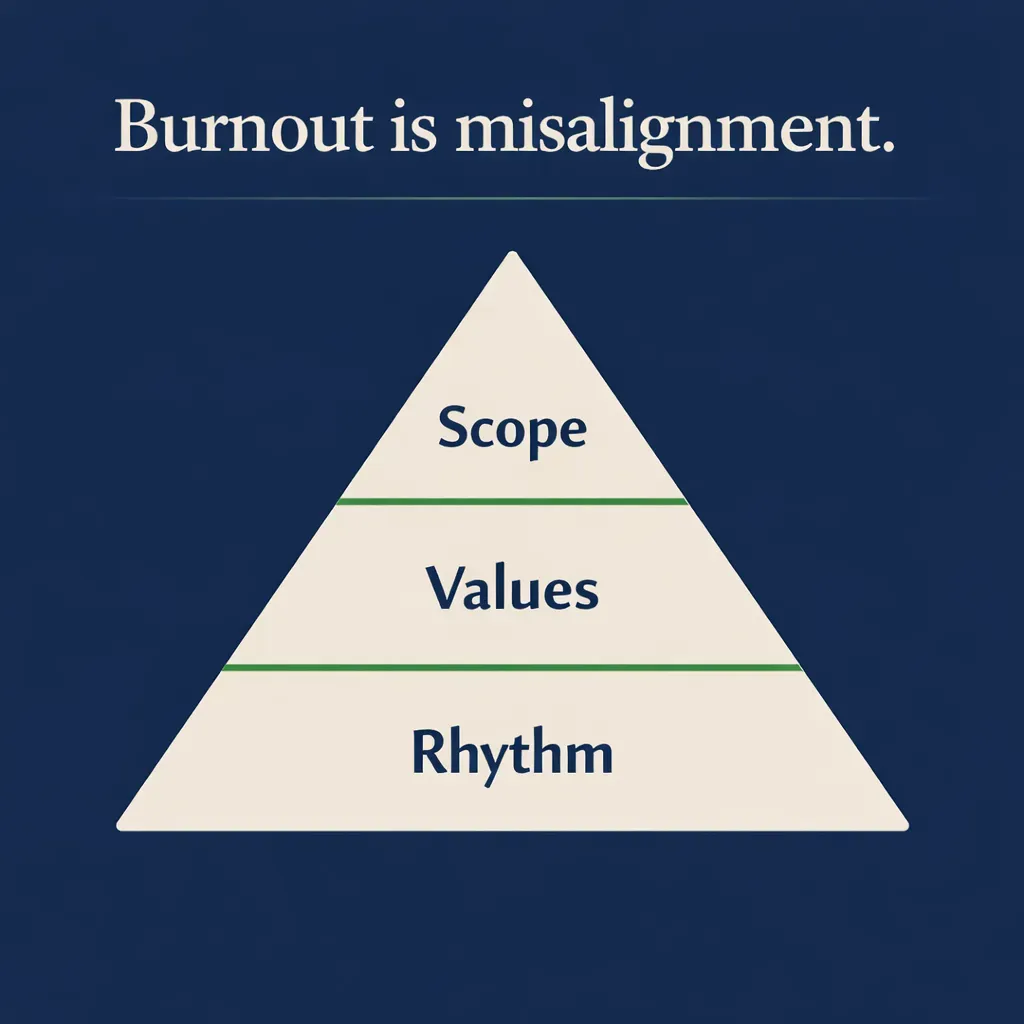
High performers increase judgement faster than the system increases scope. That mismatch creates three tensions that bleed energy even when output remains high.
Scope lag
Your judgement has moved ahead of the problems you are being asked to solve. You can deliver with your eyes closed, which sounds safe but quietly drains you.
Values conflict
You believe in clear ownership and real outcomes. The role rewards attendance and effort rather than decisions and effect. You do the work, but it does not feel like your work.
Season shift
Life season changes what you can carry with integrity. What you said yes to last year no longer fits, but the role expects the old version of you to show up.
None of these tensions is a character flaw. They are structural and seasonal. Which is why recovery days help briefly but never address the reason the friction keeps returning.
How misalignment hides in plain sight
Misalignment burnout does not always look like collapse. It sounds like polite phrases and busy calendars.
Language tells
I cannot be the only one who sees this.
We are doing a lot but I am not sure what changed.
I do not mind the hours. I mind the fog.
Calendar tells
Back to back meetings with no record of a decision.
Powerful work done in slivers and at the edges.
Time for people, none for proof.
What organisations often misread
Well-meaning leaders mistake misalignment for stamina and they offer a day off or an away day. It feels supportive and it may be needed for health, but it does not touch scope, values or season. The person returns to the same tensions, now with a little more guilt because they still feel the drag after the break.
Another miss is to offer a new title while the work stays the same. Titles lag proof. Without a shift in what you own and how the team measures effect, the badge only increases the gap between image and lived reality.
The hidden cost of staying the same
Staying in misalignment does not just feel bad. It alters how you decide and how you lead.
You start saying yes to keep the peace rather than to create value
You lower your own standards to match the environment
You stop telling the truth about risk because truth rocks the boat
You train your team to work around you rather than with you
No one chooses this. It happens slowly. It is avoidable once it is seen clearly.
What clarity sounds like when you hear it
Clarity is not a motivational speech. It is quiet and specific. You will hear people say things like these.
This is the decision and this is why it matters now.
If we accept this trade off we protect the outcome.
My work is to own this risk and make the control visible.
Here is what I will stop to make room for what actually moves us.
When clarity shows up, meetings shrink and work moves. The energy you lost to fog starts to return.
Misalignment Burnout: Two Real-Life Scenarios
The senior operator who looked fine
Her reports were on time and her team liked her. She felt cooked. Nothing was wrong and everything was off. When we looked at her actual week there was plenty of action but very little ownership of a call. The person had grown. The scope had not. Once we named it, she stopped trying to fix herself and started telling the truth about fit.
The manager with the perfect calendar
Meetings were packed and polite. The team was still behind. Every risk spawned a forum. He knew the work but avoided a simple fact. There was no shared language for value and risk. Once he could say that out loud, the story he was telling himself changed from I am failing to the way we meet does not belong to the outcomes we say we want.
These are not prescriptions. They are mirrors.
If this sounds like you
You are not broken. You are misaligned. The work has slipped out of fit with your judgement, your values or your season. If the language in this post feels uncomfortably accurate, let that be the signal. You do not need more grit. You need to see the pattern clearly enough to choose what comes next.
If you want a calm place to name the pattern and understand the cost of staying the same, you can book a short Clarity Audit. The call is diagnostic. It gives insight and next step options. The full solution lives inside a coaching partnership.
What this post is and is not
This post is an articulation of a common pattern in high performers. It is not therapy and it does not diagnose health conditions. If your symptoms suggest a medical issue, speak to a health professional first. Coaching sits beside that care and focuses on work design, leadership and decision quality.
For my background and standards, see about Rushdi and credentials and leadership coaching.


