
7 Emotional Signs It's Time for a Career Change
When success stops feeling like a fit, and your body starts telling the truth
There is a particular kind of tiredness that high performers carry quietly, and it is not the tiredness that comes from hard work. But that tiredness that comes from work that no longer excites you, feels off or draining.
If you find yourself starting to think about moving to a new role or a career change, chances are you have already talked yourself out of it a dozen times, without realising it. You tell yourself to be grateful, the company is great, the pay may be good, the perks are great, maybe the work-life balance is the best you’ve ever had. You tell yourself everyone feels this way at some point, you're overthinking this, or I’ll just push through this quarter or finish this project, or I’ll wait until the beginning of the year.
But there is a moment where the question changes. It stops being, can I keep doing this, and becomes, should I keep pushing, or am I forcing myself through something that no longer fits.
This is not a post about pros and cons lists but rather about the emotional signals that often show up before the logical ones do. It is here to validate what you may already know, and to help you name what is happening without turning it into drama or panic.
This is more common than people admit. High performers often hit a season where the role, the organisation, or life around work changes, but their responsibilities and identity stay stuck in an older version of themselves. When that mismatch grows, it can show up as fatigue, irritability, and a quiet loss of meaning, even while performance stays high and the outside world thinks everything is fine.

The myth that keeps you stuck
Most people assume a career change is a rational decision, like changing phone plans or buying a car, and they assume you decide, then you act.
In real life, a career change usually begins as a quiet internal shift because you’re still competent, still delivering outcomes, and on the outside, you look successful. But your relationship with the work changes, the work stops giving you something it used to give you, and you cannot unfeel that.
The danger is that you start treating that shift as a personal weakness, and you start convincing yourself that you are ungrateful, unstable, or too sensitive.
That is the story that keeps capable people stuck for years.
This is why the World Health Organisation frames burnout as an occupational phenomenon linked to chronic workplace stress, rather than a personal weakness or a simple resilience issue. (1)
Work psychology research on person-organisation fit shows that when personal values do not match the work environment, job satisfaction and commitment tend to drop, and the pull to leave rises over time. (2)
How to know it is time, emotionally, not just logically
If two or more of these feel true, do not dismiss it, that is usually the signal you have been trying to explain away.
1. You feel relief at the idea of leaving, not fear
Fear will always show up, but it is the relief you feel at the thought of leaving that tells you the truth.
When you imagine stepping away, and your first feeling is relief, you need to pay attention to this feeling, as this is your nervous system signalling something about fit.
2. The work feels smaller than your judgment
You can still do the work and deliver it well, but you can feel it is no longer drawing on your best judgment, which is why you find yourself thinking, surely this is not the best use of my skills and experience. What used to feel like a healthy stretch starts to feel like you are being flattened, and that often happens when your capabilities have grown but the scope of your role has stayed the same.
3. You are tired after meetings that lead nowhere
You are not tired because the work is hard, you are tired because it keeps going in circles. When your week is packed with conversations that never land at a decision point, never create clear ownership, and never change what happens next. Your energy drops even if the workload is not extreme because it feels like you are spending your life in a holding pattern.
4. You are starting to resent what used to be normal
The same requests, the same politics and the same compromises. You used to absorb it all, but now it gets under your skin, and you cannot ignore it. Often, that resentment is grief in disguise, because part of you knows you have outgrown the situation even if you are still living it.
5. You feel lonely in your role, even when you are surrounded by people
You can be in constant contact and still feel alone, especially when you do not feel seen, when your values are not shared, or when your voice has less impact than it should. That loneliness is not always about the people around you, sometimes it is the role itself that no longer matches who you are.
6. You keep fantasising about a different version of your life
You catch yourself imagining a different pace, a different kind of leadership, a different workday, and a different type of impact, and it is not unrealistic, it is grounded. That is not escapism, it is your internal compass trying to recalibrate.
7. Your confidence is starting to leak, even though you are capable
This is one of the most overlooked signs. When you stay too long in misalignment, you start questioning yourself, not because you cannot do the work, but because you no longer believe in it. That disconnect can make it feel like you are losing your edge when in reality, you are losing momentum.
Why is it so hard to admit
Because you have invested time, identity, reputation, proof, relationships, and income. A career change is not only a professional decision, but it is also an identity decision, and if you have been the reliable one, the strong one, the one who pushes through, leaving can feel like a betrayal of your own story. That is where many high performers get stuck, because they do not want to disappoint anyone, waste their experience, or feel like they are starting again.
The truth is that a career change rarely starts from scratch, it is usually repositioning what you already are into a place that fits better.
When it is not time yet
This matters too, because sometimes the answer is not to leave, it is to reset.
If your exhaustion is mainly physical and you have not properly rested, you may simply be depleted. If the problem is one person and the role still fits, it may be a solvable environment issue. If you are in a temporary season, a new baby, caring responsibilities, health recovery, or grief, you may need to change the way you work before you change the work itself. The point is not to rush, it is to stop dismissing the signal.
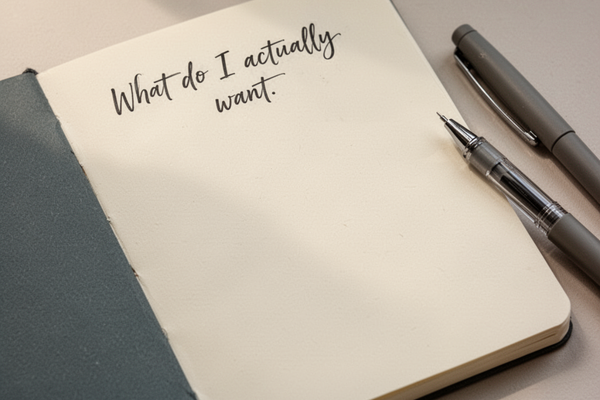
A quiet reflection
Ask yourself these questions and do not rush your answers.
What part of my work am I pretending is fine
What do I feel after a good day, satisfied or relieved it is over
If nothing changed for the next year, how would I feel
What do I miss about myself
What am I no longer willing to trade away
You do not need to answer perfectly.
You only need to answer honestly.
It is not too late
If you are reading this and thinking, I should have changed years ago, that is normal. People only see the pivot in hindsight. In real time, most transitions look messy. That does not mean they are wrong.
You are allowed to want more fit, more meaning, more calm, and more growth. Wanting those things does not make you difficult. It makes you human.
And you are not too much for wanting your work to match your life again.
Next step
If you want a calm, structured conversation to unpack what this signal is really saying, I offer a short Career Strategy Call. It is diagnostic, not a full solution, and it will help you name what is misaligned and what a sensible next move could be.
Book Your Free Strategy Reset Call
If you want to explore deeper support, you can also look at Job Ready for career direction and positioning.


