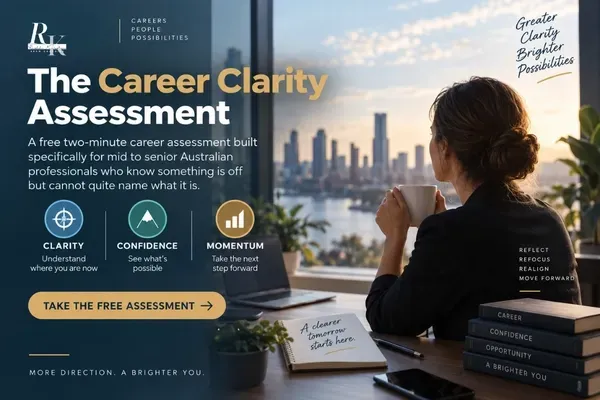
Career Assessment for Professionals: Which Type Do You Actually Need?
In summary: Most free career quizzes are built for school leavers, not experienced professionals. This guide explains the three types of career assessment that actually work at mid to senior level skills diagnostics, personality frameworks, and interest inventories what each one tells you, why assessment alone is not enough without professional coaching, and how to use your results to build a real career plan rather than just a list of possibilities.
Skills diagnostic vs personality quiz: which career assessment do you actually need?
When you search "free career quiz" online, most results are built for high school students deciding between career paths. When you have a decade or more of professional experience, being told you enjoy "working with people" does not help you map your next senior move.
To successfully navigate a professional pivot or beat mid-career stagnation, you need to understand what type of assessment is actually designed for you. There are three distinct tools, and they answer very different questions.
1. Skills diagnostics (what you can do)
A diagnostic skills assessment does not ask what you enjoy; it audits what you can actually deliver. It maps your technical capabilities, leadership competencies, and transferable strengths against real market demand. For a senior professional, this is the most powerful tool available, because it surfaces exactly which skills carry across industries and which gaps are holding you back from higher-paying or more fulfilling roles.
2. Career personality assessments (how you are wired)
Instead of scanning your resume, personality frameworks examine your working preferences, communication style, and emotional motivators. If you are experiencing professional burnout, a personality assessment can reveal something surprising: you may not hate your industry at all. You might simply be operating in a workplace culture that fundamentally clashes with how you function best. That is a very different problem — and a much more solvable one.
3. Structured interest inventories (where your strengths meet the market)
An interest inventory uses established frameworks to evaluate your values and preferences against real-world economic demand. This separates hobbies from sustainable, well-paid career paths, ensuring your next move does not just sound exciting but offers long-term financial stability and genuine professional growth.
Understanding these three methods helps you choose the right assessment for your specific situation, rather than defaulting to whatever quiz ranks first on Google.
Why does career assessment data need a professional coach to become a career plan?
A well-designed assessment gives you a clear picture of your strengths, gaps, and potential directions. But a picture is not a plan. Research consistently shows that career coaching combined with structured assessments is significantly more effective than assessments alone, providing the granularity and personalisation needed to achieve genuine career fit (Career coaching: The ADAPT framework, 2019).
A professional coach helps you do three things with your results:
Interpret, not just read. Assessment reports contain nuance that is easy to misread without guidance. A coach ensures you draw the right conclusions for your specific circumstances, improving clarity in your career choices and building confidence in pursuing new opportunities.
Set realistic goals. Results highlight possibilities, a coach turns those into a sequenced, achievable roadmap with clear timeframes, based on what the assessment has identified as your strongest areas for development.
Build momentum. Sustained career change requires accountability. Regular coaching sessions keep you on track when initial clarity starts to fade, accelerating your career progression through ongoing support.
Online platforms and professional coaching services often combine assessments with workshops and development resources, making it easier than ever to access quality guidance alongside your results.
How career assessment addresses burnout, and what it uncovers about stagnation
Career burnout and professional stagnation are rarely caused by a single factor. A structured assessment helps identify whether your situation is driven by skill misalignment, a values mismatch with your organisation, an interest gap in your current role, or simply a work-life boundary problem that has accumulated over the years.
Professional assessment and guidance are particularly valuable when navigating significant career changes and transitions (Bimrose, Barabasch, Brown, 2014). For mid-career professionals, particularly those with more than ten years of experience, assessments provide a structured reflection process that uncovers specific factors contributing to burnout, whether that is job dissatisfaction, misaligned interests, or skills that have simply outgrown the current role.
Understanding the root cause changes everything about the solution. Someone experiencing burnout due to a values mismatch needs a very different path forward than someone who has outgrown their current position. Assessments provide the diagnostic clarity to tell those situations apart, and professional guidance ensures you act on that clarity effectively, rather than jumping to conclusions or making reactive decisions.
The outcome, when done well, is three things: genuine clarity on your career direction, increased confidence in pursuing new opportunities, and a sustainable path forward that aligns your strengths with long-term professional and financial goals.
Ready to find out where your strengths can take you?
Take a free career assessment built for experienced Australian professionals, and get expert guidance on what your results actually mean for your next move.


