
The Remote Work Tax Gen-Z Won't See Until It's Too Late
The hidden cost of remote work is not productivity, it is proximity
The flexibility looks good on paper, work from anywhere, save commute time and skip the office politics. For Gen-Z entering the workforce, remote work feels like winning the career lottery.
But here's what most won't realise until years later:
They're trading immediate comfort for invisible career damage.
A lot of people who jumped into remote work are now starting to realise that because they're isolated and they don't have somebody sitting next to them where they can just wheel their chair back and ask a question, they've actually got to jump on a virtual call or find a time slot in someone's calendar. This limits them from actually asking questions and learning more about what they're working on.
The realisation comes fast, especially within the first three to six months, right after the probationary period ends, remote workers start feeling the isolation. But recognising the problem and identifying its source are two different things.
I have spent 26 years in tech and 15 in leadership, and now I coach professionals who look successful on the outside but feel stuck internally. Over the last few years, I have seen a pattern emerging in people who start their careers fully remote, and it should concern anyone who believes early career progression is only about being productive.
The Externalisation Trap
When remote workers struggle, they blame everything except the work arrangement itself.
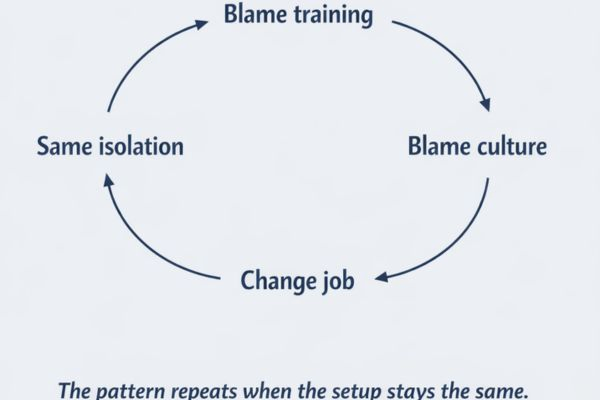
I've heard comments like “the training is inadequate”, “my colleagues don't have time”, “the workload is too heavy” or “the company culture is broken”, but they cycle through explanations, never landing on the actual cause. Generally, people tend to externalise the problem rather than looking internally, or pausing to understand what's going on and for Gen-Z or anyone that’s only worked remotely its not easy to understand or identify.
This isn't entirely their fault, most organisations hiring remote workers often fail to build proper support mechanisms, and video calls can't replicate the casual hallway conversation where an experienced colleague overhears a problem and offers a quick solution. Or the water cooler moment, where someone asks, "Hey, I've got this problem with this coding. Is it this or this?" and someone with experience responds, "Have you tried that or have you changed ….." This interaction cannot be replicated in remote work.
And that absence compounds silently.
Research confirms what I have observed in many clients I have coached, Gallup’s findings from May 2025. Only 23% of remote-capable Gen Z employees say they would prefer fully remote work, compared with 35% among each older generation. Gen Z is the most likely to say they wish employees in their organisation worked remotely less often.
They're sensing something their older colleagues haven't fully grasped yet.
The Pattern Interrupt
Most remote workers don't connect the dots until they change jobs or work in an environment that requires hybrid or full-time in the office.
After a years of struggling, they leave for a new company, thinking the previous employer was the problem. They go through another probationary period, start getting assigned projects, and find themselves in the same situation.
Some still don't realise it's remote work and continue to externalise again.
The cycle continues.
But for others, the pattern interrupt comes when the second role offers hybrid work. Maybe two days in the office, three at home. And suddenly, the contrast becomes visible.
They spend two days in the office versus three days and all of a sudden they realise when they're in the office they learn a lot from their colleagues, that's when the penny drops.
Oh, if I work in a hybrid environment rather than fully remote, I'd actually learn more very quickly.
The emotional response they usually have is regret, but it’s a silent thought, nothing out loud. Just that silent regret that builds over time and erodes confidence slowly.
But regret doesn't change the time already lost and by the time the realisation hits, they've spent one maybe two years operating in a development vacuum while in-office peers accumulated relationship capital and executive visibility they can't recover.
The Real Cost of Remote Work
When I work with clients who recognise this problem but resist changing, I run them through a simple exercise and ask these questions
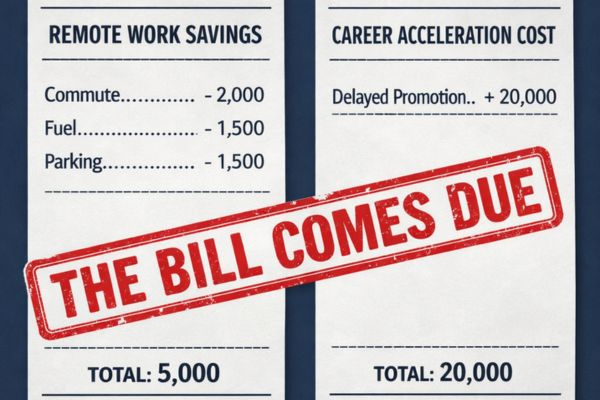
Calculate the daily savings from remote work (commute time, gas, parking, lunch.) and break it down per week, per month, per year.
Then calculate the career cost. If accelerated learning in an office environment had positioned them for a promotion two years earlier, and that promotion comes with a $20,000 raise, what's the actual cost of staying remote?
Nine times out of ten times, it doesn't come out to $20,000, but it does come out to a significant loss in opportunity. Working remotely may save you money short-term, but the lack of progression in your career costs you more money over a long period.
The math is brutal. Save $5,000 in commute costs. Lose $20,000 in delayed advancement.
But even when clients see the numbers, some still resist. Not because of fear but because the cant see the real value of progression over time and are still thinking short-term gains.
The driver for working remotely for Gen-Z is all about cost saving, like not having to do the commute to and from work and let's be honest, for some people, that commute could be more than an hour or two one way.
The immediate cost feels real and the future cost feels theoretical.
Until it's not.
What Remote Workers Are Missing
The gap isn't technical or skills because Gen-Z workers can master tools, complete tasks, and hit deadlines remotely. So this is not about their work, output or objectives, its about their learning curve.
What they're missing is harder to quantify but impossible to ignore once you see it.
Interpersonal skills.
You learn how to communicate with other people, how to talk to other people, how to read body language, how to communicate correctly, how to read a room when you walk in it. You can't read a room very well when you open a window on your screen to a virtual meeting with a bunch of faces on the screen. But if you walk into a room of people, you can read the room, the tension and the ambience
Reading a room means knowing who holds power before anyone speaks. It means sensing tension, identifying alliances, and understanding the unspoken dynamics that determine outcomes. Additionally, virtual meetings don’t allow people to openly debate constructively, because it's set up for one-to-many presentations. i.e one person speaks to many listeners
That's political intelligence, and it's almost impossible to develop remotely.
I've seen the gap clearly in how Gen-Z communicates. "They seem to abbreviate and use short abbreviations for everything and slang where they're supposed to be in a corporate environment using proper language."
When remote workers do attend in-person functions, an end-of-year party, a team event, some are meeting their colleagues for the first time. They struggle to communicate with people and intermix with people in an open social environment.
The data support this, according to Wellable, a wellness solutions provider for companies and employees. In-person work increases mentoring activities by 35% to 40%. An Axios survey found that 74% of younger workers worry about missing out on a feeling of community due to remote work, and 41% are concerned about mentoring possibilities.
But the real damage shows up when remote workers move into leadership roles.
The Leadership Gap
Can you even lead effectively if you've never learned to read the room? I kind of argue that question with: if you're actually not able to lead in that instance, you're not the right person for the job.
But organisations are still promoting people who came up remote, and that creates a generation of managers with titles, but without the fundamental political and interpersonal intelligence the role requires.
Yes, we have people with the title, but missing fundamental politics and interpersonal intelligence which builds over time, takes longer to build. These are probably going to be the managers that people would label as weak leaders.
When that gap hits at scale, these managers struggle with conflict, they don't know how to handle difficult situations with remote staff members and they default to what they can see on a screen: reports and metrics.
They focus so heavily on the team developing metrics and reports and putting it on dashboards instead of reading body language. If they're relying on reports and metrics, they are not focusing on the human side of things, they are not a people person and they are a statistical leader. That’s what many refer to as low EQ emotional intelligence.
Statistical leaders optimise the wrong things.
They measure activity instead of impact, track hours instead of outcomes and focus on dashboards instead of the human intelligence that drives actual performance.
The first 90 days in a new leadership role should be about observation. Identifying who the people are, what their strengths and weaknesses are, what processes work and which ones leak value.
But if you came up remote and never developed the skill of in-person observation, you can't do a diagnostic well. You're guessing based on what people tell you in one-on-ones, not what you're seeing in how they operate.
You don't walk in on the first day and change everything because you're the boss and everybody's just got to listen to you. If that's how some are approaching leading and managing people, they've got a very distorted view of what a manager is.
The Proximity Penalty
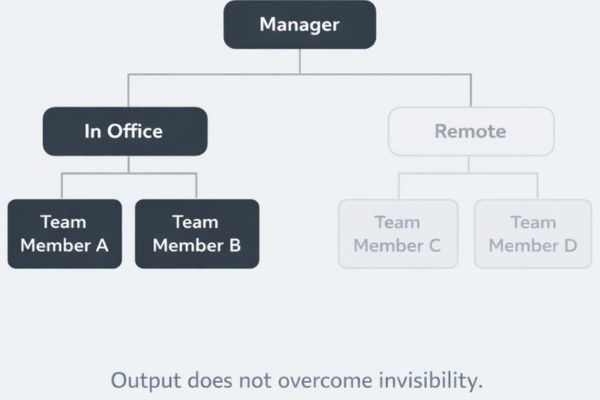
Here's the part that should concern anyone building a remote career: remote workers are getting promoted 31% less frequently than people who work in the office at least part-time.
42% of managers admit they sometimes forget about remote workers when assigning tasks. This happens despite remote workers being 15% more productive on average.
Output doesn't overcome invisibility.
Even more revealing: 67% of supervisors consider remote workers more easily replaceable than onsite workers. 72% said they would prefer all subordinates working in the office.
That's the perception gap.
Remote workers think they're proving their value through output but leadership sees them as names in email threads, not leaders in development.
Executives promote people they know, trust, and have seen perform under varied conditions. Remote workers become names in email threads, not leaders in waiting.
The relationship capital that builds through proximity, the casual conversations, the observed problem-solving, the shared pressure moments, these things compound over the years. By the time remote workers recognise what they've missed, their in-office peers have three to five years of executive exposure they can't recover.
The Self-Awareness Filter
Not everyone accepts this reality, even after seeing the numbers.
There are still some who won't accept that that is the problem and still kind of pass the blame externally and eventually, they all wise up on it. For some, it's a very quick realisation and for others it takes them a lot longer, or they keep going in that same cycle until they break."
When I coach, I know what my limitations are ascoach.
"You cannot help everybody. You cannot take everybody from point A to point B. You can only take the ones who are aware and want to do it. You can't convince somebody who doesn't want to do it."
The people who are switched on, who are self-aware, recognise the problem quickly. They don't jump to working in the office full-time. Nobody's asking them to. But they meet halfway and they embrace a hybrid model.
The ones who resist? They keep cycling through the same pattern. New job. Same isolation. Blame the company. Repeat.
Until something breaks.
The Strategic Course Correction
So what is the solution? Is remote working the problem or the fact that some don’t embrace the change that’s required?
If you're reading this and recognising yourself in the pattern, here's what matters: you can't change the past, but you can change what you do moving forward.
The question I ask many clients who recognise the problem but won't act: "If you've recognised that you haven't had progression in your learning, now you have, but you're not going to embrace it, what is the point?"
Hybrid work isn't a compromise. It's a strategic positioning decision.
Two days in the office gives you access to osmotic learning, the overheard conversations, the casual problem-solving, and the observed decision-making that accelerates early careers.
It gives you visibility with leadership, not through scheduled presentations, but through the daily interactions that build trust and demonstrate capability under varied conditions.
It gives you the interpersonal skills that separate managers from executives, reading rooms, managing up, building coalitions, and understanding organisational dynamics.
And it gives you something you can't get remotely: the ability to observe how experienced professionals operate under pressure.
"A good leader and manager goes into a one-to-one metting with his staff, not intending to tell somebody something, but to go in there and actually ask questions like a coach does,"
This is the number one thing I teach and work on with new managers: "Ask questions to actually understand what their challenges are, where they're struggling, what help they need, and then guide them through that."
You learn that by watching it happen, not by reading about it.
The Real Trade
Remote work isn't inherently bad and it's a tool. But like any tool, it has appropriate and inappropriate applications.
For early-career professionals, the trade is clear: save commute time and costs now, pay the career acceleration tax later.
The problem is the timeline mismatch.
The savings feel immediate.
The cost feels distant.
Until one day, you're five years in, watching peers who started with you move into leadership roles, and you're still in the same position, wondering why.
By then, the answer is obvious, but the time is gone.
I have been through the career collapse and the rebuild many times. I know what it looks like when someone operates below their actual capacity, not from lack of skill, but from lack of direction.
If this has made you rethink your setup, you do not need to abandon remote work overnight. You do need a clear view of what you are missing and what it is costing you in terms of learning speed, visibility, and access to mentorship.
If you want to talk it through, book a short Career Strategy Reset Call. It is diagnostic, not a full solution. On the call, we will identify where the gap is forming for you, whether it is proximity, mentorship, visibility, or role fit, and you will leave with one clear next step to test over the next 30 days. If there is a fit, we can discuss working together beyond that, either way, you still leave with understanding where you are, what's blocking progress and what your next steps.
Schedule a short Career Strategy Reset Call


