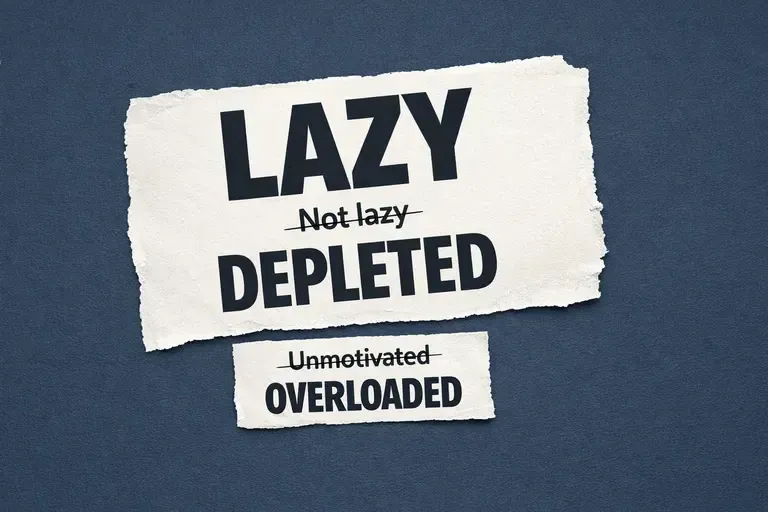
Not Broken: You’re Not Lazy, You’re Depleted
Why High Performers Are Depleted, Not Lazy or Unmotivated
What makes this so hard is that from the outside, you look fine. You still show up, you deliver, and you are the one people lean on when things get messy. So when you start feeling flat, slow, or strangely numb, you do what many high performers always do. You assume it is you or you’ve lost your edge, and assume you need to push harder.
Depletion and overload are common in high performers and leaders because responsibility keeps compounding, and when no one resets the load, it starts showing up in the body first.
But what if the problem is not your drive?
What if the problem is that your system is full?
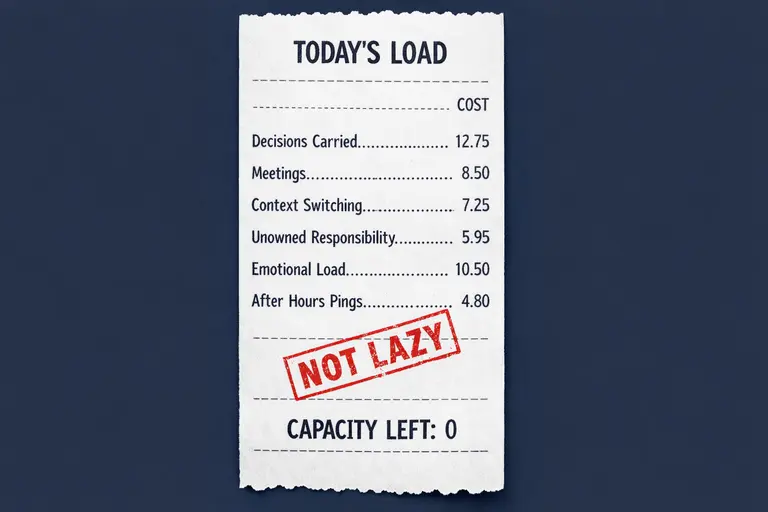
There is a kind of exhaustion that has nothing to do with work ethic. It comes from carrying too much for too long without enough control over what counts, what stops, and what you are allowed to put down.
This blog is not about a quick fix, it’s a lens that is here to help you recognise what depletion and overload actually look like in capable professionals. Because once you can name it clearly, you stop attacking yourself for a pattern that is being reinforced by the environment around you.
What depletion looks like in high performers
Depletion does not always look dramatic and often it looks like a quieter version of you.
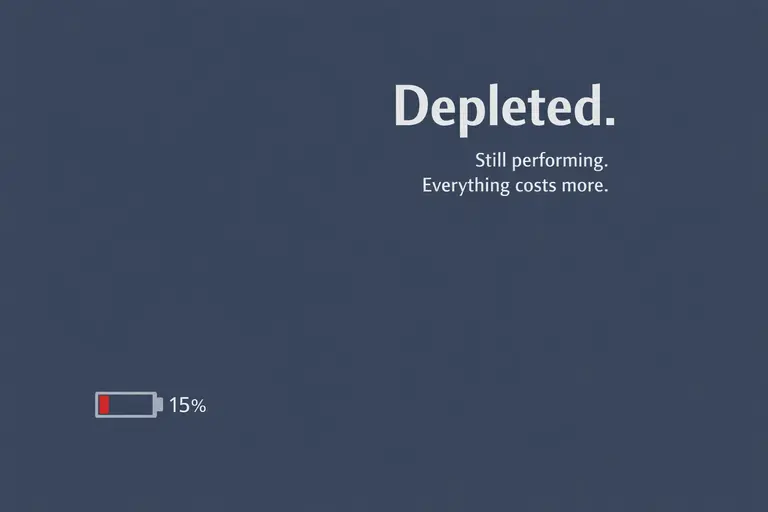
You still do the work, but everything costs more and you feel tired before the day starts. Those smallest admin task irritates you more than it should, you feel impatient with questions you used to handle calmly and your brain wants silence, not stimulation. You stop taking the initiative, not because you do not care anymore, but because you cannot afford another ball to juggle.
The worst part is that you can still perform at your high level, which then makes much easier to deny.
Depletion is not a weakness, it is your body and mind that have been running without proper recovery, not just sleep, but recovery from responsibility, decision-making, and emotional load.
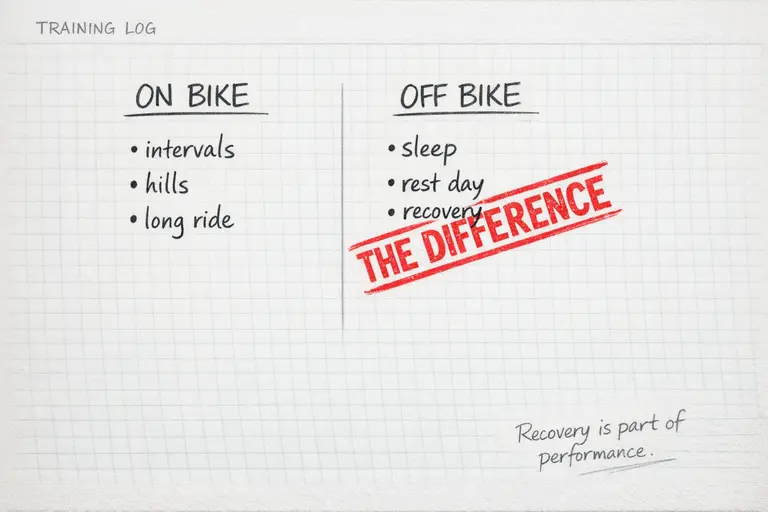
In my 20s, I raced at an elite cycling level, and the most important thing I learnt was that it wasn’t about training harder, varying intensity, or perfect nutrition, but that it was "time off the bike was just as important as time on the bike." This is what most high performers don’t do enough of, and they keep pushing without a proper reset, and believe that slowing down is a weakness.
What overload looks like when you are competent
Overload is not just a long list of tasks, it's simply too much responsibility landing on you by default, especially when the decisions are not yours but the consequences are. That shouldn’t be yours to carry alone.
It feels like you’re the person who catches everything others drop. You’re the one invited to every meeting because you are the safe pair of hands and having to carry the consequences of decisions you didn’t get to make. You’re pushed to take on responsibilities for outcomes but not in control of the inputs.
Overload is also the slow erosion of boundaries and the moment you stop asking ‘should I be doing this’ and start asking ‘how fast can I clear it’ because you are just trying to survive the week.
You are not unmotivated, you're just overloaded.
Why does this get misread as a personality problem
Because high performers often have a strong identity built around being capable.
So when capacity drops, the first story your brain tells is ‘I am failing’ and you assume it is laziness, a mindset issue and a motivation issue. You start self-correcting, with stronger coffee, more willpower, working longer hours and pushing yourself just to feel you’re on top of it all.
But depletion does not respond to shame and overload does not respond to grit.
If your week is full and your role is unclear, pushing harder simply locks you deeper into the same pattern.
The quiet signs you are not broken
If any of these feel familiar, pay attention.
You feel relief when meetings cancel, not because you are disengaged, but because your nervous system is begging for space.
You avoid starting tasks because you do not have the energy to finish the loop.
You feel most tired after work that has no clear outcome or no clear owner.
You resent work you used to handle easily.
You snap at small questions that you used to answer calmly.
You keep thinking ‘I just need a break’ but you know the break will not change the structure that created the load.
What looks like laziness is often depletion, and what looks like lost motivation is often overload.
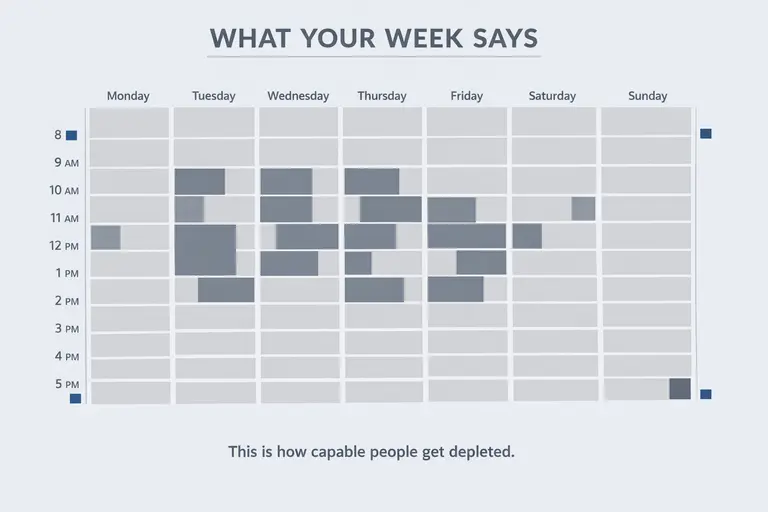
A short story that might sound familiar
A client described it as becoming slower and snappier at the same time. Slower because their capacity was dropping and snappier because everything annoyed them. They were still performing, still reliable, still trusted, but the cost was starting to show in their body and in their mood. They thought they needed a new role, but what they needed first was a clearer way to name what was happening, so they could stop blaming themselves and start making better choices.
Nothing changed overnight, but the story they told themselves changed. From 'I am failing' to 'I am overloaded.' And that shift alone reduced the shame, which made the next decisions possible.
If this is hitting a nerve
If reading this makes you feel exposed, good. Not because you should suffer, but because it means you have named something real. The moment you stop calling it laziness, you stop trying to punish your way back to performance.
I wrote this not as a read this, and it will fix you, but to remind you that you are not broken. If you notice any symptoms that are affecting your sleep, health, or mood in a serious way, consult a health professional, because this post is perspective and not medical advice.
If you want to talk it through, book a short Career Strategy Reset Call. It is diagnostic, not a full solution. On the call, we will identify whether you are dealing with depletion, overload, misalignment, or a mix, and you will leave with one clear next step to test. If there is a fit, we can discuss working together beyond that.
Schedule a short Career Strategy Reset Call: https://rkgrowcoaching.com.au/schedule


